

National Board of Review: 2025-26
Jan 03 2026
The National Board of Review: History, Relevance, and the 2026 Awards Season
The National Board of Review of Motion Pictures (NBR) is one of the oldest and most influential film institutions in the world, founded in 1909 in New York. Originally established as the New York Board of Motion Picture Censorship, its early purpose was to examine films at a time when cinema was viewed with suspicion and moral anxiety. By 1916, the organization shifted away from censorship and adopted its present name, redefining its role as a critical and educational body committed to promoting cinema as an art form.
Over time, the NBR became an important advocate for artistic freedom, film literacy, and critical appreciation, positioning itself not as a trade guild but as a thinking body of cinephiles, scholars, critics, and professionals. This intellectual orientation continues to distinguish it from industry-based awards.
The National Board of Review Awards
The National Board of Review Awards, first presented in 1929, are among the earliest film awards in history. Announced every year in early December, they are traditionally the first major awards of the U.S. film awards season, often setting the tone for discussions that follow at the Golden Globes, critics’ circles, guild awards, and the Oscars.
What makes NBR awards distinct is their curatorial approach. Rather than relying on mass voting, the organization screens hundreds of films annually and engages in deliberative discussion, focusing on cinematic intent, authorship, form, and cultural relevance.
Major Award Categories
The NBR honours cinema across creative, technical, and cultural dimensions. Its core awards include:
Top Honours
- Best Film
- Top 10 Films of the Year
Direction & Performance
- Best Director
- Best Actor
- Best Actress
- Best Supporting Actor
- Best Supporting Actress
- Breakthrough Performance
Writing
- Best Original Screenplay
- Best Adapted Screenplay
Craft & Technique
- Best Cinematography
- Best Film Editing
Film Categories
- Best Animated Film
- Best International Film
- Best Documentary
- Top 10 Independent Films
- Top 5 International Films
- Top 5 Documentaries
Special Recognition
- Freedom of Expression Award
- Best Ensemble
- Special Achievement / Career Achievement Awards
Not all special categories are awarded every year; they respond to the cultural and artistic context of each season.
Cinematography and Visual Language
The Best Cinematography award holds particular critical prestige. Unlike technical guild awards, the NBR evaluates cinematography as visual authorship—how light, camera movement, framing, scale, and texture serve narrative meaning. Historically, NBR has often recognised auteur-driven, large-format, or visually radical films, sometimes ahead of mainstream consensus.
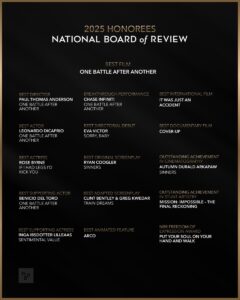
The 2025 Awards (97th National Board of Review Awards – Ceremony in 2026)
The 97th National Board of Review Awards, honouring films released in 2025, were announced in December 2025, with the ceremony held in January 2026 in New York.
Major Winners
- Best Film: One Battle After Another
- Best Director: Paul Thomas Anderson – One Battle After Another
- Best Actor: Leonardo DiCaprio – One Battle After Another
- Best Actress: Rose Byrne – If I Had Legs I’d Kick You
- Best Supporting Actor: Benicio del Toro – One Battle After Another
- Best Supporting Actress: Inga Ibsdotter Lilleaas – Sentimental Value
- Breakthrough Performance: Chase Infiniti – One Battle After Another
- Best Original Screenplay: Sinners – Ryan Coogler
- Best Adapted Screenplay: Train Dreams – Clint Bentley & Greg Kwedar
- Best Animated Film: Arco
- Best International Film: It Was Just an Accident

Top 10 Films of the Year
- One Battle After Another (Best Film)
- Avatar: Fire and Ash
- F1
- Frankenstein
- Jay Kelly
- Marty Supreme
- Rental Family
- Sinners
- Train Dreams
- Wake Up Dead Man: A Knives Out Mystery
- Wicked: For Good
Relevance in Contemporary Cinema
The National Board of Review remains relevant because it:
- Acts as an early critical compass for the awards season
- Champions cinematic language over commerce
- Balances mainstream, independent, and international cinema
- Preserves a tradition of thoughtful evaluation rather than predictive voting
While NBR selections do not always align with Oscar outcomes, they consistently reflect how cinema is evolving, not merely which films are most rewarded.
The National Board of Review stands as a bridge between cinema history and contemporary practice. Its awards are less about winning races and more about recognising intention, craft, and meaning. For students, filmmakers, and scholars, the NBR offers a valuable lens through which to understand what cinema values at a given moment in time.
The National Board of Review and the Award for Outstanding Achievement in Cinematography
The National Board of Review Awards, first presented in 1929, are among the earliest annual film awards in history. Announced every year in early December, they traditionally mark the beginning of the U.S. awards season, often shaping early critical discourse ahead of guild awards and the Academy Awards. Unlike industry voting bodies, the NBR operates through curated screenings and deliberation, emphasizing cinematic intention, authorship, and craft over commercial success
Among its most respected honours is the Award for Outstanding Achievement in Cinematography, which recognises cinematography not merely as technical execution but as visual storytelling—the expressive use of light, camera movement, framing, texture, and scale to serve narrative meaning. The award has historically favoured auteur-driven imagery, formal experimentation, and bold visual authorship, often anticipating broader recognition later in the awards cycle.

In the 97th National Board of Review Awards (2025 film year, ceremony held in 2026), the Award for Outstanding Achievement in Cinematography was presented to Autumn Durald Arkapaw for her work on Sinners. The recognition highlighted the film’s distinctive visual language and reaffirmed NBR’s long-standing commitment to celebrating cinematography as a core element of cinematic expression rather than a subsidiary craft.
More than a century after its founding, the National Board of Review continues to function as a critical compass—bridging cinema’s past with its evolving present. Its awards do not aim to predict winners but to identify significance, making them especially valuable to filmmakers, students, and scholars seeking to understand how cinema thinks, not just how it competes.
Article by
CJ Rajkumar
Author/ Cinematographer