
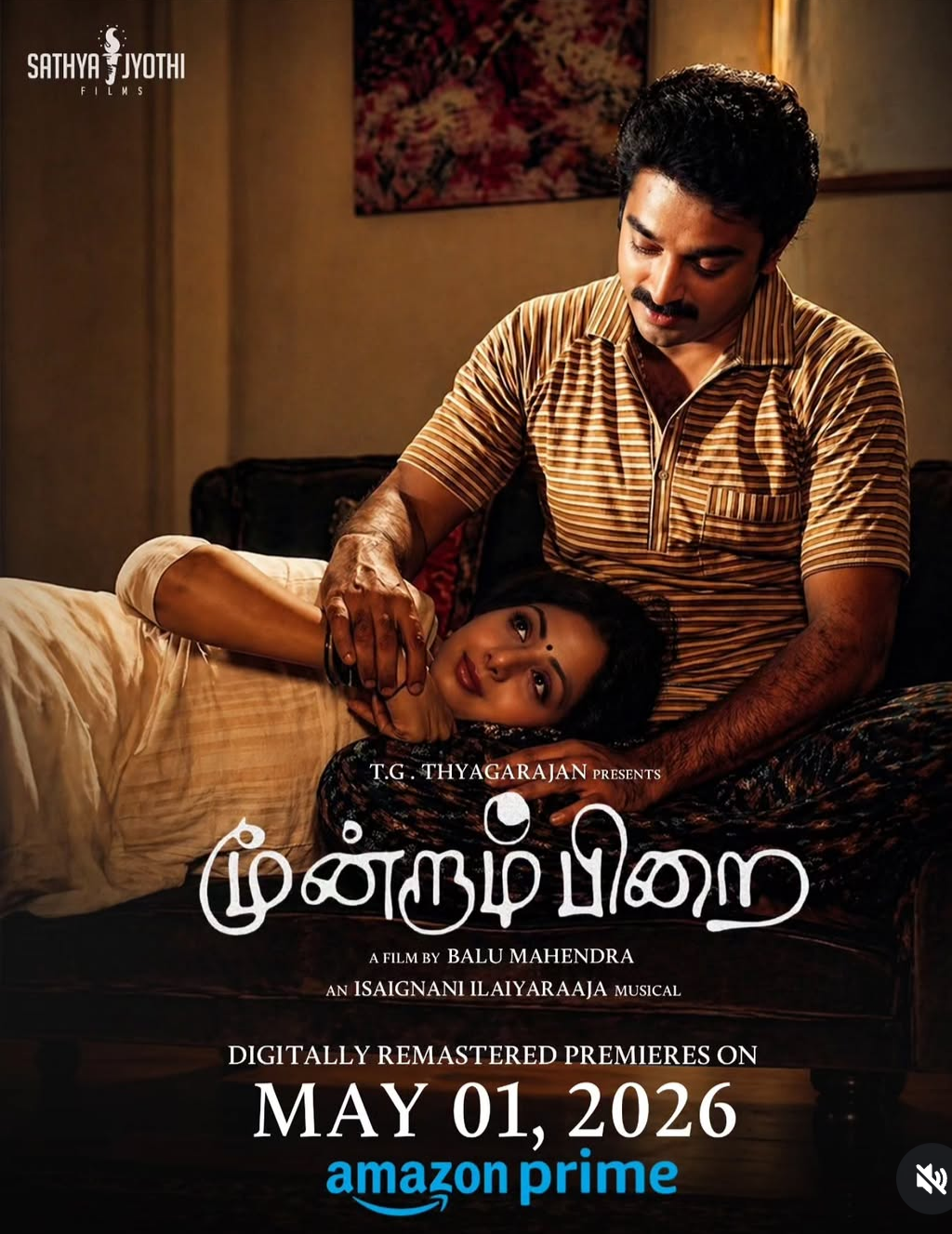
Revisiting : Moondram Pirai !
May 01 2026
Moondram pirai by Legendary Balu Mahendra is now streaming with a restored version – Amazon Prime!
Moondram Pirai (1982) – A Love That Refused to Become a Memory
Written & Directed by Balu Mahendra
Produced by Satyajothi Films always known for a high quality film production.
There are films that succeed. There are films that stay. And then, there are films like Moondram Pirai—they don’t just remain… they haunt.
Balu Mahendra didn’t make a love story. He carved a fragile human experience out of silence, rain, loneliness, and longing. Even today, decades later, the film breathes.
Casting – When Actors Disappeared Into Souls
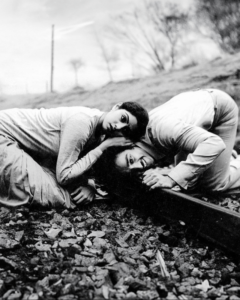
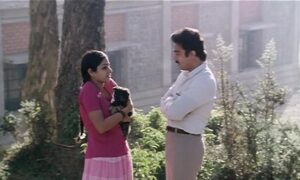
Kamal Haasan (Srinivasan / Cheenu)
Not a performance—an internal collapse. Kamal didn’t “act” love; he carried it like a burden. His restraint, body language, and those eyes that constantly held back something unspoken… this is one of Indian cinema’s greatest portrayals of unrequited love.
Sridevi (Bhagyalakshmi / Viji)
Perhaps one of the most daring performances of her career. To play a woman regressed into childlike innocence without slipping into caricature requires frightening precision. Sridevi becomes fragile, unpredictable, tender—and heartbreakingly unreachable.
Silk Smitha (Subtle but striking presence)
Even in limited screen time, she adds texture to the emotional and social environment of the film.
Songs – Ilaiyaraaja’s Soul in Sound
Ilaiyaraaja didn’t compose songs here—he whispered emotions into music.
“Kanne Kalaimaane”
A lullaby that feels like a goodbye. Written by Kannadasan in his final days, it carries a strange sense of completion. It’s not just a song—it’s a man soothing a love he knows he cannot keep.
“Poongatru Puthithaanathu”
Air, freedom, longing… the melody floats like the hills of Ooty themselves.
Background Score
Minimal, haunting, and deeply internal. Silence is used as music. Music is used as memory.
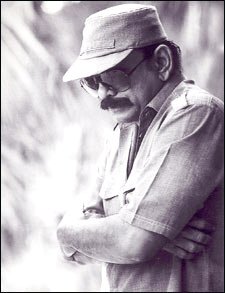
Cinematography – Balu Mahendra’s Poetry in Light
This is where Moondram Pirai becomes immortal.
Shot largely in natural light, the film breathes realism.
Mist-filled Ooty landscapes mirror the emotional fog of the characters.
Frames are not composed—they feel discovered.
The camera doesn’t intrude; it observes like a silent witness.
Every frame feels like a memory you are afraid to revisit.
At the time, this was a revolutionary choice for Indian cinema, and it’s a detail that often separates a casual fan from a true student of cinematography.
The Magic of the Canon K35s in *Moondram Pirai*
The K35 series (released in the 1970s and winners of an Academy Award in 1976) were instrumental in creating the film’s distinctive “dreamy yet sharp” texture. Here is why those lenses mattered:
The “Glow” and Halation: The K35s are famous for their unique way of handling light. When Balu Mahendra shot the sun peeking through the Ooty pine trees (the *Komorebi* effect), these lenses produced a soft, organic flare and a gentle “glow” around the highlights that modern, clinically sharp lenses simply cannot replicate.
Fast Apertures for Natural Light: These were “fast” lenses (many at T1.3 or T1.5). This allowed him to shoot in extremely low-light conditions—like the dim interiors of Cheenu’s house or late evening shots—without having to flood the set with artificial studio lights. This preserved the shadows he loved so much.
Skin Tone Rendering: The K35s are known for a slightly warm, golden tint and a smooth rendering of skin. In Moondram Pirai, this helped humanize the characters, making Sridevi’s childlike innocence and Kamal’s weary kindness feel physically “warm” on screen.
Contrast and Depth:Unlike the flat, high-contrast lenses common in the 80s, the K35s offered a lower contrast that allowed for more detail in the mid-tones. As you often mention in your own work, **”depth lives in the mid-tones,”** and Mahendra used these lenses to prove exactly that.
Technical Trivia for the Cinephile
It’s fascinating to note that these same lenses are now some of the most sought-after “vintage” glass in Hollywood today (used on films like Her and American Hustle). Balu Mahendra was decades ahead of the curve, recognizing that the “character” of the lens is just as important as the resolution of the film stock.
By pairing the Arriflex cameras of that era with Canon K35 glass, he created a visual language that felt like a bridge between European realism and Indian emotionality.
Performance – The Art of Holding Back
The brilliance of the film lies in what is not expressed.
Kamal’s suppressed affection
Sridevi’s unaware innocence
The unsaid tension between protection and desire
There are no dramatic declarations. No loud confrontations. Just human vulnerability unfolding quietly.
The Ending – One of Cinema’s Most Devastating Climaxes
No exaggeration—this is one of the greatest endings ever filmed.
When Sridevi regains her memory, she forgets everything that happened during her regression… including the man who loved her without expectation.
Kamal Haasan’s character, now reduced to desperation, tries to remind her—jumping, pleading, performing like a clown in a railway station.
But she doesn’t remember.
And the train leaves.
That moment is not just heartbreak—it is erasure. Love existed. But memory denied it.
No background score manipulates you. No melodrama forces tears. Yet the silence screams.
Awards & Recognition
National Film Award – Best Actor (Kamal Haasan)
National Film Award – Best Cinematography (Balu Mahendra)
Tamil Nadu State Awards and multiple critical recognitions
Widely regarded as one of the finest films in Indian cinema history
Hindi Remake – Sadma (1983)
Balu Mahendra himself remade the film in Hindi.
Kamal Haasan reprised his role
Sridevi delivered the same haunting performance
Sadma brought the story to a wider audience, but interestingly, over time, it achieved cult status—especially because of its unforgettable climax.
Why It Remains One of the Greatest Love Stories Ever
Because it defies everything we expect from love stories.
No union
No closure
No reward
Just pure, selfless love that existed without acknowledgment.
This is not a story about being loved back.
It is about loving despite knowing it may never return.
Balu Mahendra asks a painful question:
If love is not remembered… did it ever exist?
And answers it visually—with a man running beside a moving train, trying to hold onto something that has already left.
Legacy
Moondram Pirai stands as:
A masterclass in visual storytelling
A benchmark for performances
A lesson in emotional restraint
A reminder that cinema can be deeply personal, yet universally understood
It is not just a film.
It is a wound… beautifully preserved.
Article by
CJ Rajkumar
Author/ Cinematographer
—