
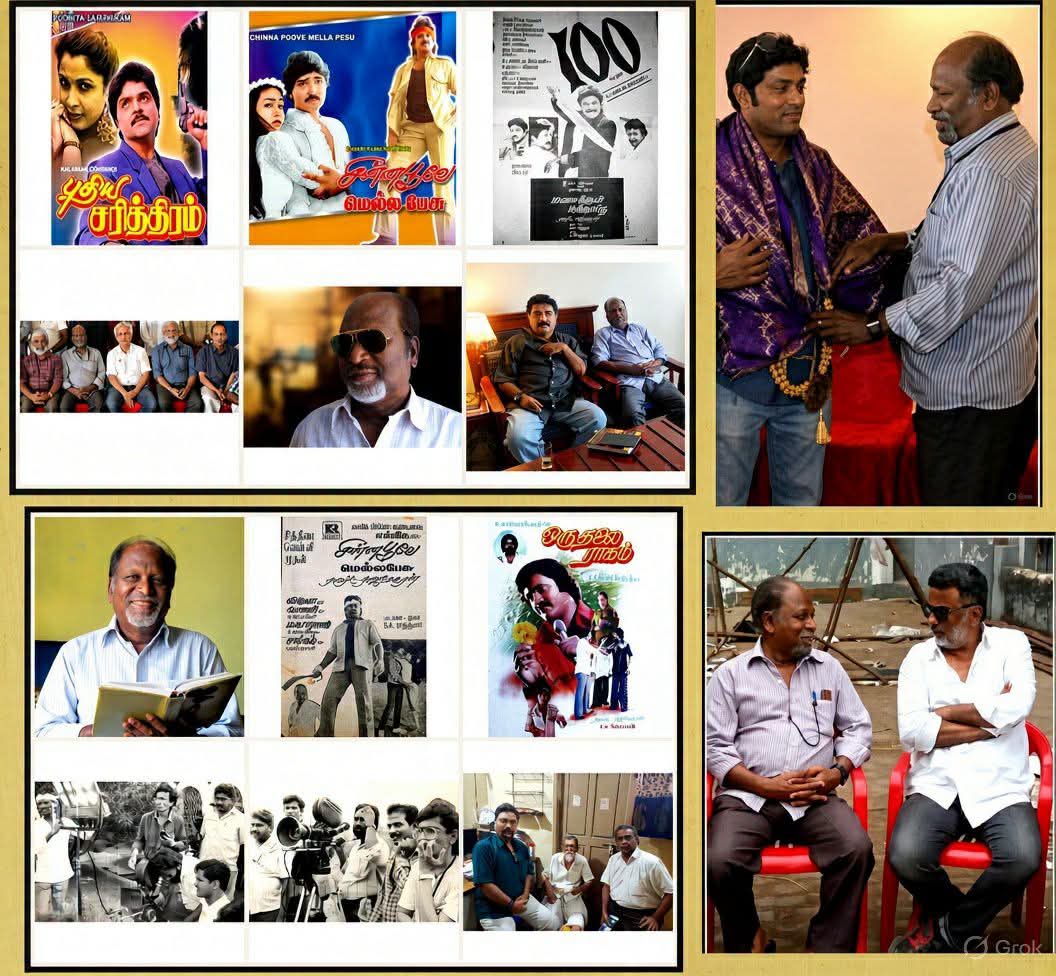
Robert Ashirvatham sir : Ravindhar DOP!
Oct 05 2026
Humanity Personified… A True Human Being… That Is Robert Asirvatham.
Memories from Ravindhar Cinematographer

That day, I contacted my friend Madhu to meet him. When I asked, “Will you be home this evening?”, he replied, “No sir, this evening I am going to see my old friend and veteran cinematographer, Bukhari Sir.” The moment I heard the name ‘Bukhari Sir’, the wheel of time spun backward in my mind. “Is it the same Bukhari Sir whom our cameraman Robert Sir affectionately called ‘Annachi… Annachi…’ with all his heart?” I asked eagerly. When Madhu confirmed it was indeed him, filled with a deep desire to meet him, I immediately set off from ECR. Around 6:30 PM, both of us reached Bukhari Sir’s home together. He was waiting just for us.
Over 85 years old, that veteran artist is no ordinary person. He was the primary disciple of the renowned Dadasaheb Phalke Award-winning cinematographer V.K. Murthy Sir. Furthermore, he earned the pride of mastering the light and shadows of the camera by working as an assistant to legends like B.L. Rai, Mastan, and Viswanath Rai. Bukhari Sir was one of those people whom Robert Sir loved most and held in heartfelt esteem throughout his life; he harbored immense affection for him.
As he conversed with us, Bukhari Sir struck the chords of his old memories. “When we were working on the film Deergha Sumangali, Robert and Rajasekar joined as assistants under B.L. Rai Sir. Both of them were Film Institute students. Robert had even worked there as a lecturer, but he came to B.L. Rai Sir seeking practical experience. B.L. Rai Sir and Viswanath Rai Sir had immense respect and love for Robert, and Robert possessed equal reverence for them.”
With moist eyes, he continued with deep emotion, “Robert was very fond of me. Whenever he saw me, he would call out with warmth and intimacy, ‘Annachi… Annachi…’ It was purely because of his love that I worked alongside him right from Oru Thalai Ragam all the way to Manasukkul Mathappu.”
As Bukhari Sir recounted this, my respect for Robert Sir grew manifold. As grand as he was as a human being, the way he transformed the visual language of Tamil cinema as an artist and cinematographer through his camera eyes always leaves me in awe. Only when we closely examine the nuances of his cinematography and direction do we truly comprehend the full dimension of that genius who lived and passed away for us.
In early black-and-white films like Kudisai, Robert’s handling of ambient lighting was a monumental challenge for that era. When shooting outdoors on Panchromatic film rolls, the techniques he used to manage contrast and achieve precise tonal value between black and white were extraordinary. In particular, his technical brilliance in enhancing the authenticity of light and shadow outdoors using filters like Wratten No. 15 (G), 5N5, and Neutral Density (ND) filters is staggering. In those days without heavy equipment, relying primarily on available light to delicately capture the character’s nuanced emotions remains a testament to his genius.
The cinematography of Oru Thalai Ragam is like a sacred textbook for film students. Executing complete scene compositions by mounting a camera inside the narrow compartment of a moving train is no ordinary feat. The choice of lenses, the tight close-ups capturing the actors’ subtle expressions, and the artistic use of incoming window light attuned to the characters’ moods were entirely groundbreaking for Tamil cinema. More than dialogue, his camera angles directly conveyed all the anguish and solitude of unrequited love straight into the hearts of the audience.
The films directed by Robert–Rajasekar were not merely commercial entertainers, but poignant narratives exploring the deep pains and emotions of the human psyche.
Palaivana Solai: Captured the life of middle-class youth and the sacredness of unexpected friendship with utmost naturalness. By shunning artificial sets in favor of real locations, the audience could seamlessly connect with the film. The fluid camera movements effortlessly guided the audience through the narrative journey.
Manasukkul Mathappu: A masterpiece that maturely tackled complex psychological conflicts of the human mind. The softness in visual framing and the realism in lighting reflected the emotional gravity of the story in a profoundly moving manner.
Chinna Poove Mella Pesu
Once, Mr. Annadurai Kannadasan (son of the legendary poet Kannadasan) shared some fascinating memories about the late cinematographer and director Robert (of the Robert–Rajasekar duo) that still echo in my ears. Robert and Rajasekar maintained a wonderfully harmonious and healthy pact between themselves: in one film, Robert would serve as the cinematographer and Rajasekar as the director; in the very next film, Rajasekar would take up cinematography while Robert would direct. They shared such an ego-free, extraordinary understanding.
For the film Chinna Poove Mella Pesu, debut music director S.A. Rajkumar was signed. With Robert Sir playing the guitar, Rajasekar tapping the rhythm on a bucket, and Rajkumar singing… a humble ‘budget composing session’ took place at the S.K. Productions office. Intrigued with life and vibrancy, all ten songs of the film were birthed right there.
After the tracks turned out brilliantly, Robert Sir crafted a storyline tailored to them. He envisioned a premise: what if the heroine left alone after the hero’s death in Oru Thalai Ragam went on to become a college professor? That narrative evolved into the movie Chinna Poove Mella Pesu, becoming a blockbuster hit.
Robert Sir, who gave his assistant directors complete creative freedom on set, was intensely logical during story discussions, constantly probing with sharp questions until he received satisfactory answers. Major producers harbored immense respect and affection for him. Being an exceptionally patient soul who never lost his temper, the entire crew affectionately nicknamed him “Jesus Christ,” as recalled touchingly by Annadurai Kannadasan.
I first met Robert Sir at our South Indian Cinematographers’ Association (SICA). Serving on the union committee granted me the privilege of meeting him frequently. With stalwarts like B.N. Sundaram Sir on one side and Robert Sir on the other, the association was a grand academy for us. He treated me with affection like his own brother. He would often invite me to his home in Saligramam and spend hours sharing the nuanced crafts and techniques of cinema. Those moments remain the treasures of my life.
Born in Golden Rock (Ponmalai), Trichy, as the son of an ex-serviceman, Robert Asirvatham grew up in a family of eight children. Developing a passion for photography through his father Jesudhas, he initially honed his craft using a field camera. Although he completed his B.Sc. in Physics at Pachaiyappa’s College, Chennai, in 1970, his camera and passion for art never parted from him. This quest led him to enroll in the Diploma in Cinematography at the Film Institute of Chennai, where he met his lifelong friend and collaborator, Rajasekar.
After a brief stint in the Department of Archaeology, Robert served for three years as a lecturer (Demonstrator) at the very film institute where he studied. Such was his unquenchable passion for art and his students that he would take them outdoors at his own expense to train them in natural lighting techniques. Among the stellar students groomed by his constructive critiques and encouraging guidance, the renowned cinematographer P.C. Sreeram stands as a notable luminary.
Beginning in the late 1970s, Robert Sir’s journey spanning several decades did not end with celluloid film rolls. Having etched his indelible mark as a cinematographer during the golden era of analog cameras, he continuously updated himself technically through the advent of color cinema and into the modern era of digital cinema cameras.
Later, when N.K. Viswanathan Sir became the president of SICA, Robert Sir stood firmly by his side, extending immense support.
Robert Sir never viewed cinematography as merely a profession; he revered it as his breath and a sacred penance. The dedication he showed toward SICA’s educational initiatives and the selfless guidance he imparted to the next generation of cinematographers will keep his name immortal as long as Tamil cinema endures. The demise of this noble artist, who served the field of cinematography with utmost truth and integrity until his final breath, is an irreplaceable loss we can never fully digest.
Taking leave of Bukhari Sir, I was riding my bike back along the Beach Road, weighed down by memories. Just then, floating through the air from the tape recorder of a passing auto-rickshaw came that melody from Palaivana Solai, directed by Robert Sir:
“Megame Megame… Paal Nila Theyuthe…Thegame Theyinum Thenoli Veesuthe…”
(O Cloud, O Cloud… the milky moon is waning… Even if the body wears away, it continues to radiate sweet light…)
“Thegame Theyinum…” (Even if the body wears away…) — what profound and poignant lines! Today, Robert Sir is no longer with us. Yet, as a genius, the works he captured within his camera and the artistic footprints he left behind will never fade; they will live on in our memories foreve
r, radiating eternal light.
Translation by
CJ Rajkumar