
Godox Knowled Series : SICA event – Tinnu international
Aug 31 2026
Views: 102
GODOX KNOWLED Cinema Lighting: From Powerful Sources to Precision Spectral Control

SICA Hosts a Special Cinema Lighting Event in Association with Tinnu International
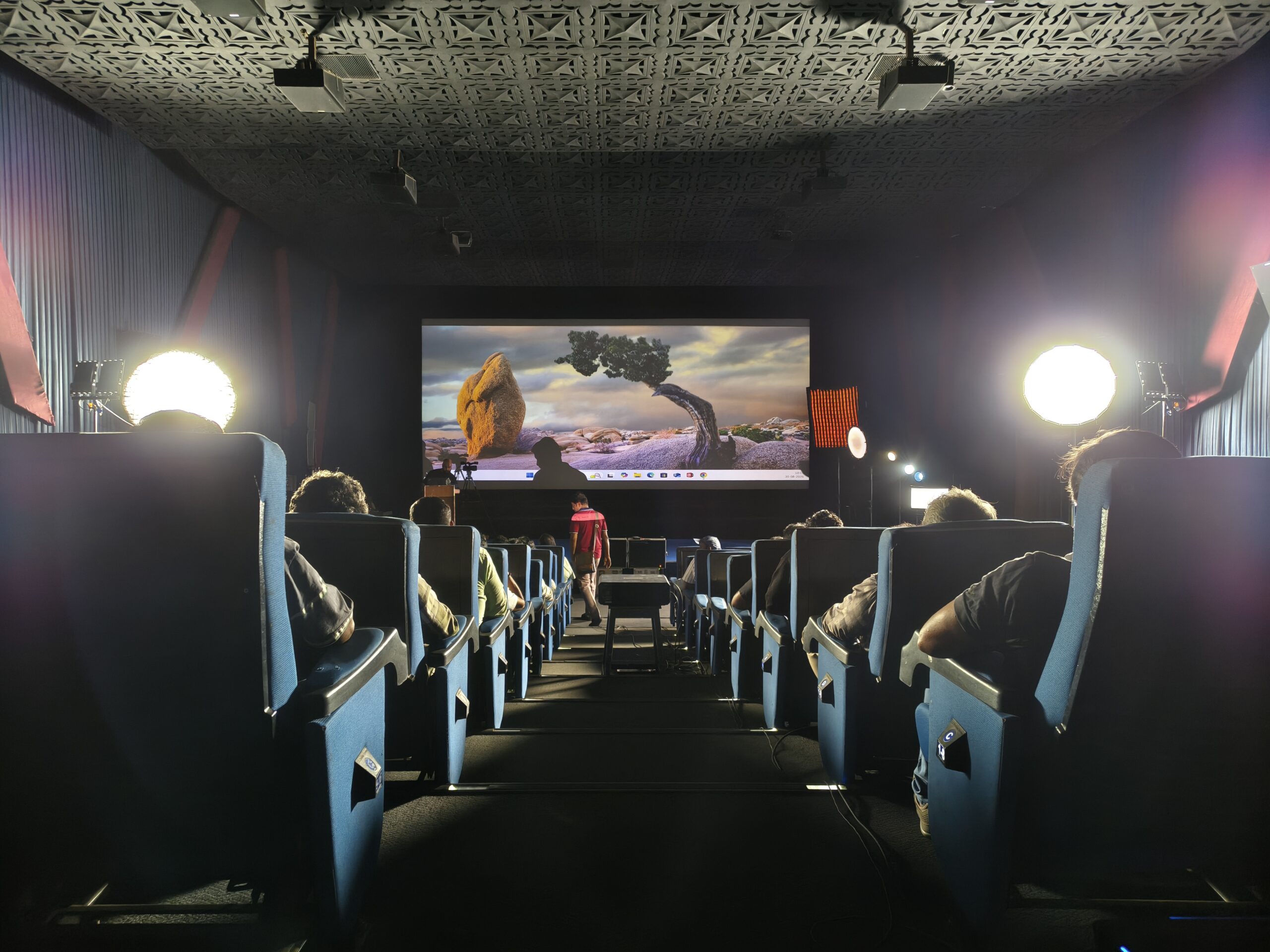
The Southern India Cinematographers Association (SICA), in association with Tinnu International, hosted a special GODOX KNOWLED Cinema Lighting event at the Prasad Film Laboratories Theatre on Sunday morning, 30th August.
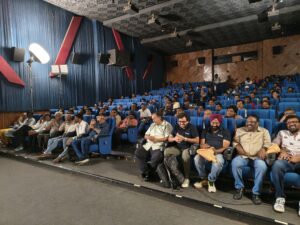
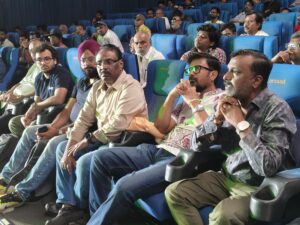
Organised as part of the Cam benefit TRUST programme, the event attracted a packed audience of SICA members, professional cinematographers, filmmakers, technicians and students.
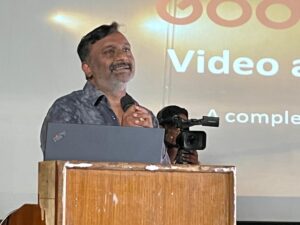
The programme was anchored by author and cinematographer CJ Rajkumar.
It was not merely a product presentation. The event brought together cinematographers and lighting professionals to examine the changing landscape of cinema lighting—from high-output LED sources and large-set illumination to spectral accuracy, colour control and sophisticated light-shaping systems.
Remembering a Legend of Prasad Film Laboratories
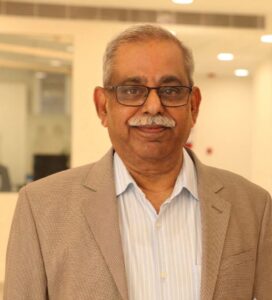
The programme began on a solemn note with two minutes of silence in memory of S. Sivaraman, a legendary figure and the Chief of Prasad Film Laboratories.
His contribution and association with the film industry were remembered with great respect.
SICA President A. Karthik Raaja and Dean of MGR Film Institute Manoj Paramahamsa shared memories, anecdotes and their experiences associated with Sivaraman sir.
For generations of filmmakers and cinematographers, Prasad Film Laboratories has been an important part of the technical history of Indian cinema. Remembering Sivaraman at a programme held at Prasad therefore added a particularly poignant significance to the occasion.
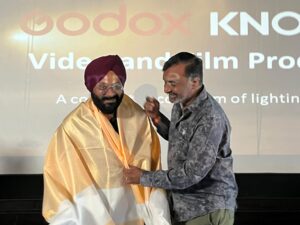
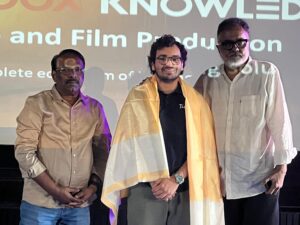

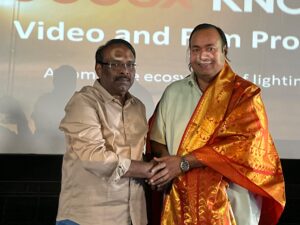
Honouring the GODOX and Tinnu International Teams
The representatives associated with the event were honoured on stage by PC Sreeram, A. Karthik Raaja, Rathnavelu and Manoj Paramahamsa.
The GODOX KNOWLED and Tinnu International representatives honoured were:
– Mandar Dewalkar – Product Specialist, GODOX KNOWLED
– Gurpreet Sodhi – Senior Sales
– Deepak Bhandari – Managing Director, Tinnu International
– Amit Bhandari – Director, Tinnu International
The presence of senior cinematographers and industry professionals made the occasion an important meeting point between lighting technology and the filmmaking community.
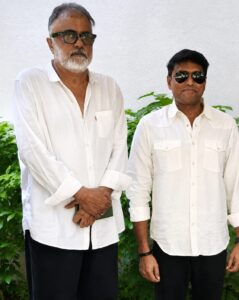
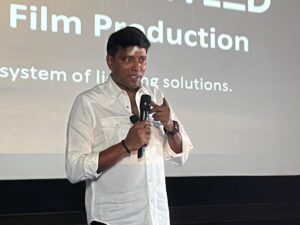
Rathnavelu: KNOWLED on the Sets of Peddi
One of the highlights of the programme was the discussion by ace cinematographer Rathnavelu on his experience using GODOX KNOWLED lighting for the film Peddi.
His presentation provided a valuable perspective because it moved the discussion from product specifications to the realities of working on a major film set.
Rathnavelu explained how the KNOWLED panel lights could be used not only as strong, high-output sources, but also transformed into large, soft sources depending on how they were positioned, modified and controlled.
This flexibility becomes particularly valuable when illuminating large sets.
Instead of relying exclusively on conventional approaches involving multiple lamps, cranes, extensive diffusion and separate fixtures for hard and soft lighting, a powerful LED panel source can be adapted to the requirement of the scene.
The same lighting family can therefore become:
– A powerful directional source
– A large soft source
– A bounced source
– A diffused source
– A daylight source
– A controlled fill
– A source for large interior sets
– A high-output source for large-scale production environments
For a cinematographer, the real advantage is not simply output—it is control over the quality, direction, size and character of that output.
Rathnavelu’s experience on Peddi demonstrated how this flexibility can translate into practical advantages when working with large production sets.
The discussion also illustrated an important evolution in LED lighting: high-output panel fixtures are no longer restricted to being soft sources. With sufficient power and the right approach, they can perform as powerful sources while also being capable of producing broad, controlled illumination.

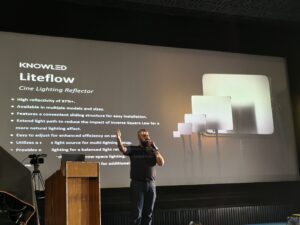
Introducing the KNOWLED Cinema Lighting Family
Following Rathnavelu’s presentation, Mandar Dewalkar, Product Specialist – GODOX KNOWLED, took the audience through the KNOWLED lighting ecosystem step by step.
The presentation covered the philosophy behind the KNOWLED range, its different families of fixtures, accessories, control systems and light-shaping tools.
The KNOWLED ecosystem is designed to address different requirements—from compact production lighting to high-output cinema fixtures capable of illuminating large sets.
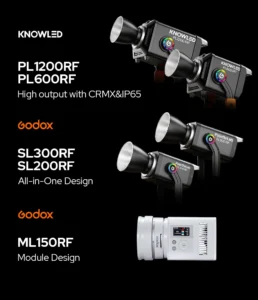
The broad KNOWLED family includes product lines such as:
KNOWLED MG Series

The MG series represents high-output point-source lighting designed for demanding production environments.
Godox KNOWLED MG Series is a lineup of ultra-high-output, professional Godox LED cine monolights built to match the intensity of traditional heavy-duty HMI studio lights.
These fixtures are particularly useful where cinematographers need substantial output from a relatively controllable source.
Depending on the model and configuration, MG fixtures can be used through diffusion, bounce, reflectors and other modifiers.
Applications include:
The strength of a high-output point source is the ability to maintain useful illumination even after passing through substantial diffusion or travelling considerable distances.
KNOWLED M Series
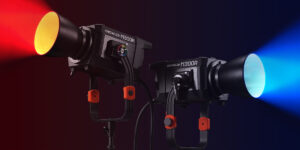
The M series expands the KNOWLED ecosystem with high-performance fixtures designed for professional film and television production.
Godox Knowled M Series is a line of professional, high-output COB LED monolights designed for cinematography, broadcasting, and large studio productions.
The M family focuses on delivering powerful, controllable illumination while retaining the flexibility expected from modern LED cinema fixtures.
These fixtures can be integrated into a cinematographer’s lighting design as:
– Key lights
– Backlights
– Rim lights
– Daylight sources
– Night sources
– Large soft sources
– Bounce sources
The ability to modify the source gives cinematographers considerable freedom in shaping the final image.
KNOWLED P Series
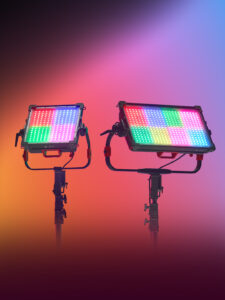
The P series is panel lights another important part of the KNOWLED ecosystem, offering powerful LED lighting solutions for professional production.
P-series fixtures are particularly useful where a cinematographer requires substantial output combined with precise colour and intensity control.
With suitable modifiers, the source can be adapted for different lighting styles, allowing the fixture to move from a harder source towards a softer, more cinematic illumination.
This versatility is particularly useful on fast-moving productions where lighting requirements can change rapidly from one setup to another.
KNOWLED TP Series

The **TP series ** brings another dimension to the KNOWLED range, particularly for applications requiring versatile LED lighting with advanced colour control.
These fixtures can be used for creative colour effects as well as conventional white-light cinematography.
For filmmakers, RGB and extended colour-control capabilities can provide opportunities for:
– Practical-light simulation
– Colour ambience
– Background illumination
– Production-design enhancement
– Nightclub and music-video looks
– Stylised narrative lighting
– Virtual production environments
The important development is that colour becomes an integrated part of the lighting instrument rather than something that always has to be achieved through gels.
P-Lite Lab: The Importance of Spectral Quality
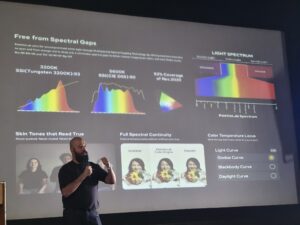
Among the most technically interesting discussions of the day was the KNOWLED Palette Lab series.
For cinematographers, colour temperature alone does not define the quality of a light.
Two fixtures may both be set to 5600K and still produce visibly different images.
The reason is their spectral distribution.
The palette Lab series was presented with a strong emphasis on spectral performance, with the discussion highlighting 92% coverage of the Rec.2020 colour space.
The objective is to produce light with a spectral character that allows cameras to reproduce colours more naturally and consistently.
This becomes particularly important with:
– Skin tones
– Costumes
– Production design
– Paintings and artwork
– Coloured surfaces
– Natural materials
– Mixed-light environments
Daylight and Tungsten Character
One of the interesting advantages discussed was the ability of the Palette Lab series to reproduce lighting characteristics closer to familiar natural and conventional sources.
At 5600K, the source can be used for daylight-oriented applications.
At the warmer end, the technology can be tuned towards the visual character associated with traditional tungsten-filament sources.
The discussion particularly highlighted its behaviour around 3200K, where the spectral quality is intended to provide a more natural tungsten-like rendering than simply changing the numerical colour-temperature setting.
This distinction is important.
Setting an LED fixture to 3200K does not automatically make it behave like a tungsten lamp.
The spectrum matters.
This is where spectral-engineered lighting can provide cinematographers with a more sophisticated tool for recreating familiar sources.
Why Spectral Quality Matters to Cinematographers
A cinematographer ultimately judges a light through the camera.
The question is not:
“Does the light say 5600K?”
The more important questions are:
How does the skin look?
How are colours rendered?
How does the camera see the red, green and blue components?
Does the source reproduce the desired character of daylight or tungsten?
How does it compare with the practical sources already present on the set?
Modern cinema cameras are capable of capturing enormous amounts of colour information. This places greater importance on the spectral quality of the light illuminating the scene.
The Practical Demonstration
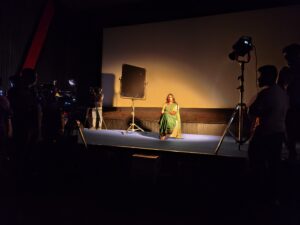
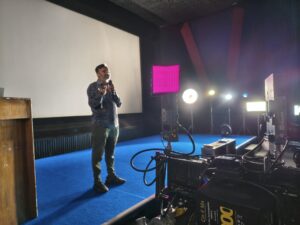
After the tea break, the event moved from the theatre to the practical floor.
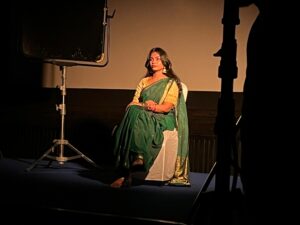
Multiple digital cinema cameras were positioned to test the KNOWLED fixtures, with a female model placed on stage.
The practical session allowed cinematographers to evaluate the lights directly through cinema cameras.
Rather than simply looking at the fixture, participants could observe the actual image produced by the source.
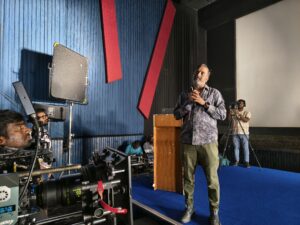
Manoj Paramahamsa Tests P-Lite Lab
Ace cinematographer Manoj Paramahamsa conducted one of the key demonstrations.
He tested the character of the P-Lite Lab source using a cross-key lighting technique, while a LiteFlow reflector was used to provide controlled fill.
This demonstrated how a cinematographer can combine a precisely controlled LED source with a reflector to create depth while retaining natural modelling on the face.
The reflector becomes particularly useful because it allows the cinematographer to control the fill without introducing another powered light source.
5600K Camera Rating vs 2800K P-Lite Lab
One of the most interesting demonstrations involved a direct comparison between a traditional tungsten-filament light and the P-Lite Lab.
The camera was white-balanced and rated at 5600K.
First, a conventional tungsten-filament source was introduced.
The P-Lite Lab was then brought into the comparison.
The P-Lite Lab source was adjusted to approximately 2800K, allowing the audience to observe its ability to produce a tungsten-like visual response through the camera.
The demonstration became a practical lesson in colour science.
It showed that the numerical Kelvin value is only one part of the equation.
The spectral distribution of the source determines how the camera actually interprets the light
LiteFlow: Shaping Light Without Adding Another Lamp
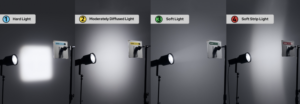
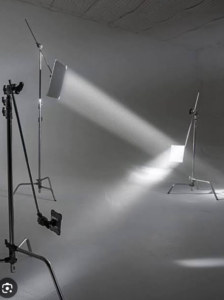
The introduction of LiteFlow reflectors added another important dimension to the lighting discussion.
Reflection is one of the oldest tools in cinematography, but modern reflector systems allow cinematographers to exercise much greater control over the direction and quality of bounced light.
A high-output source can be directed towards a LiteFlow reflector and then shaped onto the subject.
This provides:
– Controlled fill
– Soft reflected illumination
– Directional bounce
– Greater flexibility in tight locations
– Reduced dependence on additional powered fixtures
– More precise control over the lighting ratio
For cinematographers, this is an extension of the lighting source rather than simply another accessory
TimeLink and Digital Lighting Control
Modern cinema lighting increasingly requires the ability to control multiple fixtures quickly and consistently.
The KNOWLED ecosystem incorporates advanced control possibilities, including TimeLink-based workflows on compatible systems, allowing lighting changes to be integrated into sophisticated production environments.
Digital control offers significant advantages when:
– Multiple fixtures are being used
– Lighting cues need to be repeated
– Complex colour changes are required
– Virtual production is involved
– The same lighting setup has to be recreated
– A cinematographer needs to make rapid adjustments without physically accessing every fixture
The result is a shift from lighting as a collection of individual lamps to lighting as a digitally controllable system.

KNOWLED Accessories: Completing the System
The strength of a modern lighting ecosystem lies not only in the fixtures but also in the tools used to shape them.
The KNOWLED presentation introduced accessories and light-shaping solutions including:
LiteFlow Reflectors
For controlled bounce, fill and directional reflected light.
Diffusion and Light-Shaping Tools
For transforming powerful sources into larger, softer sources.
Reflectors and Modifiers
For controlling beam direction, spread and intensity.
Digital Control
For precise adjustment of intensity and colour on compatible fixtures.
Together, these tools allow cinematographers to build different lighting architectures around the same basic fixture.
KNOWLED: From Source to System
One of the strongest messages from the event was that the modern cinema light should not be judged purely by wattage.
A professional cinematography light must be evaluated by several parameters:
Output + Colour + Spectrum + Control + Beam Character + Modifiers + Reliability
A high-output source without control can be difficult to use.
A colour-accurate source without sufficient output may not work on a large set.
A powerful source without appropriate modifiers may not provide the desired softness.
The KNOWLED philosophy attempts to bring these requirements together within a single ecosystem.
KNOWLED Lineup at a Glance
KNOWLED Family| Primary Strength| Typical Cinematography Applications
MG Series| High-output point source| Large sets, daylight, night exteriors, diffusion
M Series| Powerful professional LED source| Key, backlight, daylight, interiors
P Series| High-output versatile lighting| Feature films, commercials, large interiors
TP Series| Advanced colour/creative lighting| Backgrounds, ambience, stylised scenes
P-Lite Lab| Spectral quality and colour science| Natural daylight, tungsten character, skin tones, colour-critical work
LiteFlow| Precision reflection and light shaping| Fill, bounce, modelling, controlled soft light
TimeLink / Control| Digital workflow and repeatability| Multi-light setups, complex productions, virtual production
Exact output, power, photometric performance and feature sets vary by individual model.
The Cinematographer’s Advantage
The greatest advantage of a modern KNOWLED lighting system is the ability to change the character of the source without completely rebuilding the lighting setup.
A cinematographer can start with a powerful source and then decide:
Hard or soft?
Daylight or tungsten?
Direct or bounced?
Key or fill?
Natural or stylised?
High output or controlled low level?
This adaptability is especially valuable on large productions where time is critical.
Many DOPs Get Hands-On
Following the formal demonstrations, several cinematographers had the opportunity to operate and test the fixtures themselves.
The practical nature of the event encouraged participants to explore different combinations of sources, modifiers, reflectors and colour temperatures.
For working cinematographers, this kind of hands-on testing is more meaningful than specifications alone.
Ultimately, every light must answer to the camera.
SICA Appreciates the New Technology
SICA Treasurer Sakthi Saravanan appreciated the new generation of lighting technology and thanked the GODOX team and Tinnu International for bringing the KNOWLED range to the cinematography community.

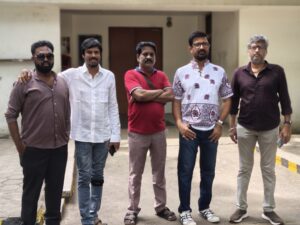
The event was supported by SICA Executive Committee members Moses, Gopi Jagadeewaran, Loganathan, Srinivasan, Naga Saravanan and many others who contributed to its successful execution.
Veteran cinematographers Balasubramanieum and M. S. Prabhu were also present.
Lighting Is Moving From Illumination to Image Creation
The GODOX KNOWLED event demonstrated an important change taking place in contemporary cinematography.
Cinema lighting is no longer simply about producing enough light to expose an image.
It is increasingly about controlling the complete behaviour of light.
Output determines how far the source can travel.
Spectral quality determines how colours are reproduced.
Modifiers determine the size and character of the source.
Control systems determine how quickly the cinematographer can change the image.
And ultimately, the cinema camera determines whether all these decisions translate into the desired picture.
Rathnavelu’s experience with KNOWLED on Peddi demonstrated the practical value of powerful panel sources on large sets, where the same lighting technology could function as both a strong source and a soft source.
The P-Lite Lab demonstration with Manoj Paramahamsa further took the discussion into the domain of spectral science and source matching.
Together, the presentations showed that the future of cinema lighting is not simply about more light.
It is about better light, smarter control and greater creative freedom.
For cinematographers, that can only mean one thing:
More possibilities for the image.
Article by
CJ Rajkumar
Author | Cinematographer
x
^