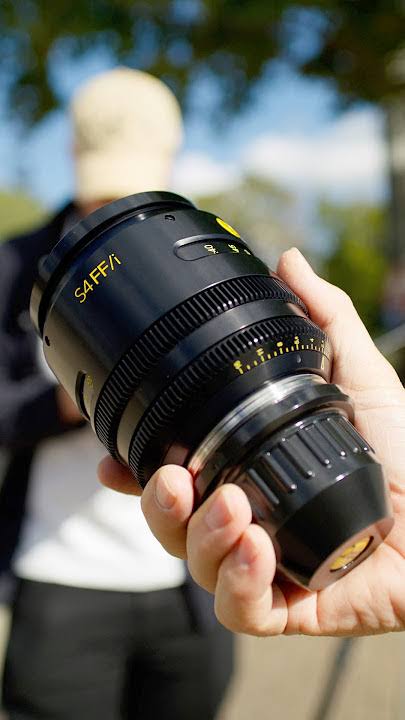
Cooke s4i FF- new dimension!
Oct 23 2026
COOKE S4 FF/i: THE LEGACY RETURNS, REIMAGINED FOR FULL FRAME
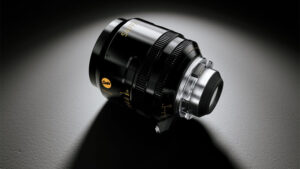
From the celebrated S4/i to a new generation of large-format cinematography
The Cooke Look was never just about sharpness. It was about the way a lens interprets a face, renders a highlight, embraces a flare and gives an image its emotional character.
When Cooke introduced the S4 series in 1998, it established a new benchmark for modern cinema primes. The subsequent S4/i generation combined this celebrated optical character with intelligent lens-data technology, becoming a trusted companion for cinematographers across film and digital productions. Designed for Super 35, the S4/i family offered a comprehensive range of focal lengths, from 12mm to 300mm, with a maximum aperture of T2 across most of the series.
Yet, even as camera technology moved towards larger sensors, one thing remained unchanged: the affection many cinematographers had for the S4/i image.
The S4/i legacy: Character beyond resolution
The original S4/i lenses were engineered for optical consistency, controlled aberrations, smooth focus mechanics and dependable performance at full aperture. But their appeal went beyond engineering.
Cinematographers came to value their distinctive rendering of skin tones, nuanced contrast, controlled flare and pleasing out-of-focus areas. The resulting images could feel refined without appearing clinically sharp or emotionally detached.
The Cooke Look became shorthand for a particular balance between technical precision and visual warmth. It was not about making every image soft; it was about retaining detail while giving faces, colours and highlights a natural, expressive quality.
The introduction of Cooke /i Technology in 2005 added another dimension to the S4/i legacy, bringing lens metadata into the digital filmmaking workflow. Focus and iris information, alongside other lens data, helped connect traditional optical craft with increasingly sophisticated post-production requirements. [1]
The large-format transition: S7/i and S8/i
The arrival of large-format digital cinema cameras changed the demands placed on cinema lenses. Cameras such as the ARRI ALEXA LF, Sony VENICE and RED V-RAPTOR XL/VV opened new possibilities in field of view, depth of field and image composition.
However, a lens designed specifically for Super 35 does not automatically cover a full-frame sensor. Using a larger sensor requires optics designed to illuminate the larger image area, unless the camera is operated in a compatible cropped mode.
For cinematographers who wanted to retain Cooke’s approach to colour and dimensionality while embracing large-format capture, the S7/i and later S8/i families became important options.
The S7/i brought Cooke’s spherical prime philosophy to full-frame production, while the S8/i represented a newer optical generation designed for large-format filmmaking. The S8/i family offers a broad focal-length range and a consistent T1.4 maximum aperture across its standard prime lineup, with focal-length-specific exceptions and configurations to be checked against the manufacturer’s specifications.
But an optical family can evolve without every cinematographer wanting the same evolution in image character.
Many operators continued to seek the qualities associated with the S4/i: its familiar skin-tone rendition, expressive flare and particular balance of sharpness and warmth. The desire was not simply to cover a bigger sensor. It was to retain a visual language while gaining the freedom of a larger image format.
Introducing the Cooke S4 FF/i: The Look, evolved
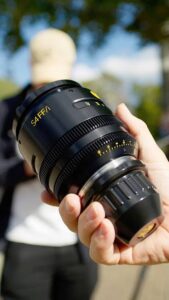
Announced on 20 October 2026, the **Cooke S4 FF/i** is a full-frame evolution of the iconic S4/i S35 family. Rather than merely enlarging the original lenses’ image circle, Cooke has developed a new optical design intended to preserve key aspects of the S4/i character while meeting the requirements of contemporary full-frame cameras.
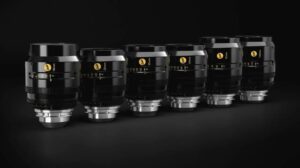
The new series consists of six spherical prime lenses:
18mm · 25mm · 35mm · 50mm · 75mm · 100mm
All six lenses feature a maximum aperture of T2.0 and are available in PL or LPL mount. Cooke’s stated priorities include compact construction, close-focus capability, consistent image character and modern lens-data integration.
The concept is compelling: bring the spirit of the much-loved S4/i into a format that works naturally with today’s large-sensor cameras.
What makes the S4 FF/i special?
1. Full-frame coverage without sacrificing the S4 philosophy
The S4 FF/i is designed to cover full-frame sensors, with Cooke listing compatibility with cameras including the RED V-RAPTOR VV, Sony VENICE and ARRI ALEXA LF.
This means cinematographers can use the full sensor area rather than relying on a Super 35 crop, while retaining a rendering philosophy rooted in the S4/i heritage.
The larger format offers more flexibility in framing and depth-of-field choices. The exact visual result, of course, depends on focal length, subject distance, aperture, sensor format and camera position.
2. A familiar relationship with skin tones
Cooke describes the S4 FF/i as inheriting the original S4/i’s natural skin-tone rendition, with gentle clarity rather than an excessively clinical appearance.
This is especially relevant in narrative cinematography, where close-ups carry emotional weight. The way a lens reproduces facial texture, tonal transitions and highlights can influence the audience’s perception of a performance.
The objective is not to remove detail, but to render it in a way that remains pleasing and expressive.
3. Expressive flare with controlled contrast
Lens flare is not merely an optical defect to eliminate. In the hands of a cinematographer, it can become part of the visual design.
Cooke describes the S4 FF/i flare as layered and expressive, with veiling flare taking on the colour of the source. The intended result is a subtle reduction in contrast without the entire frame dissolving into uncontrolled haze.
For backlit faces, practical lights, sunsets and carefully designed night interiors, this character can become a creative tool rather than an accidental artefact.
4. Smooth bokeh and natural dimensionality
The S4 FF/i uses a nine-blade iris with curved blades, compared with the eight straight blades of the original S4/i S35. According to Cooke, this helps preserve rounder bokeh as the lens is stopped down.
The company also describes gentle contrast fall-off and consistent sharpness towards the frame edges. These characteristics aim to balance a modern level of detail with a sense of depth that remains natural rather than exaggerated.
5. Close focusing for intimate cinematography
Close-focus capability is one of the notable practical advantages of the new series.
Cooke quotes the following minimum focusing distances, measured from the camera sensor:
| Focal length | Close focus |
| 18mm | 300mm |
| 25mm | 280mm |
| 35mm | 280mm |
| 50mm | 350mm |
| 75mm | 450mm |
| 100mm | 650mm |
The average is approximately 385mm. This provides cinematographers with greater flexibility when photographing hands, objects, food, details and intimate close-ups without immediately switching to a dedicated close-focus lens.
Actual framing and magnification still depend on focal length and camera-to-subject distance.
6. Compact construction for modern production
Despite its full-frame coverage, Cooke has prioritised size and weight.
All six lenses share an 87mm front diameter, helping simplify matte-box and accessory changes across the set. The lenses weigh between 1.45kg and 1.8kg, including the base PL mount, according to Cooke.
Their compact construction is particularly useful for handheld cinematography, Steadicam and gimbal work, where lens weight and balance can affect operating comfort, rigging and movement.
7. Modern metadata for VFX and virtual production
The S4 FF/i incorporates Cooke’s latest /i Technology. The system relays real-time focus and iris-position information, motion inertial data, and individually calibrated lens shading and distortion maps.
These data can support visual-effects integration, lens compensation, camera tracking workflows and virtual production. They are particularly useful when the production needs repeatable optical information to connect what was photographed on set with the work completed in post-production.
The benefit is not only convenience: accurate lens metadata can improve the consistency and predictability of complex image-making pipelines.
Official technical specifications
| Specification | Cooke S4 FF/i |
| Optical format | Full frame |
| Focal lengths | 18, 25, 35, 50, 75, 100mm |
| Maximum aperture | T2.0 throughout |
| Aperture range | T2–T16 |
| Mounts | PL and LPL |
| Front diameter | 87mm throughout |
| Focus rotation | 270° |
| Iris rotation | 75° |
| Iris construction | Nine curved blades |
| Lens weight | 1.45–1.8kg, including base PL mount |
| /i Technology | Focus, iris and motion data; calibrated shading and distortion maps |
| Manufacturing | Handmade at Cooke’s Leicester, UK factory |
These specifications are drawn from Cooke’s official S4 FF/i product information. Individual lens dimensions, close-focus distances, filter provisions and other details vary by focal length.
Why the S4 FF/i matters
The significance of the S4 FF/i is not simply that Cooke has introduced another full-frame prime set. The more interesting development is the return of the S4 identity in a lens family designed specifically for the demands of contemporary sensors and production workflows.
The original S4/i earned its reputation in the Super 35 era. The S7/i and S8/i helped address the creative and technical requirements of large-format cinematography. Now, the S4 FF/i offers a new route for filmmakers who want full-frame coverage without abandoning the optical character associated with the S4 lineage.
It is also important to understand that no lens can guarantee a particular cinematic look on its own. Lighting, production design, exposure, filtration, camera placement, colour management and the cinematographer’s choices remain essential. A lens provides a set of optical possibilities; the cinematographer decides how to use them.
For filmmakers who have long appreciated the S4/i aesthetic, the new S4 FF/i presents an intriguing proposition: familiar character, a new optical design, full-frame coverage and a more production-friendly physical package.
The sensor may have grown, resolution may have increased, and workflows may have become more complex. But the desire for images that feel human, dimensional and emotionally alive remains the same.
With the S4 FF/i, Cooke is bringing that enduring philosophy into a new chapter of cinematography
Drafted
CJ Rajkumar
Author/ Cinematographer