

Visual world of Dorothy: Tirru
Oct 31 2026
DOROTHY: When the Landscape Becomes an Emotion

Cinema is at its most powerful when the image transcends its descriptive function and becomes an expression of human emotion. Karthik Subbaraj’s *Dorothy* is a compelling example of this possibility. Through its sensitive treatment of friendship, identity, masculinity and acceptance, the film creates a cinematic experience in which the landscape, the performances, the music and the camera become inseparable from the emotional journey of its characters.
For a cinematographer, *Dorothy* is particularly rewarding because of the visual intelligence with which it transforms its narrative world. Cinematographer S. Thirunavukkarasu, popularly known as Tirru, does not merely photograph the rural landscape of Tamil Nadu; he allows the geography to participate in the storytelling. The mountains, barren fields, meadows, dusty roads and confined domestic spaces become extensions of the characters’ inner lives.

Direction and Blocking: The Geography of Human Relationships
Karthik Subbaraj’s direction demonstrates an understanding of how physical space can communicate emotional relationships. The blocking of characters within a frame becomes a language of power, vulnerability and transformation.
The patriarchal household of Veeraiya is presented as a confined and emotionally oppressive environment. Its physical condition reflects the absence of warmth and care. The house becomes an expression of a social structure dominated by masculine authority, family honour and violence.
In contrast, the open landscapes provide the characters with a different emotional vocabulary. The relationship between Subbu and Karthi evolves through their movement within these spaces. Their friendship, conflict and eventual understanding are communicated not only through dialogue but also through their physical relationship with the environment.
The long-take action sequence near the interval is particularly interesting from a cinematographic perspective. By allowing the camera to remain within the space, the filmmakers preserve the geography of the action and the emotional tension of the moment. The audience experiences the violence as an event unfolding in real time rather than as a series of disconnected visual fragments.
This is a valuable lesson in cinematic blocking: the arrangement and movement of characters can create dramatic intensity without depending entirely on editing.
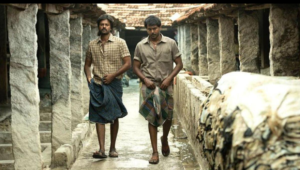
Sensitivity: From Violence Towards Compassion
At its emotional core, *Dorothy* is a film about the possibility of transformation.
The characters are shaped by a world in which masculinity is associated with aggression and emotional restraint. As the narrative progresses, these assumptions begin to change. Subbu’s emotional development and Karthi’s struggle with inherited social conditioning become central to the film’s dramatic movement.
The performances communicate this transformation through subtle behavioural details. A pause, a hesitation, a change in eye contact or a moment of silence becomes emotionally significant.
The camera respects these moments. It does not always need to move closer or underline the emotion through dramatic visual emphasis. Sometimes, the distance between characters communicates more than a close-up.

This restraint is particularly valuable in cinematography. Emotional sensitivity is not necessarily achieved through visual exaggeration; it often emerges from allowing the audience to observe the character without interference.
Period Authenticity: Reconstructing a World Through Its Textures
The period setting of *Dorothy* is convincing because authenticity extends beyond costumes and props.
The architecture, the physical condition of the locations, the natural environment and the social atmosphere contribute to the recreation of the past. The visual world possesses a lived-in quality.
Tirru’s approach to texture is particularly noteworthy. The harsh sunlight, the earth, the dust, the skin and the natural colours of the landscape are retained with a sense of realism.
The cinematography does not excessively desaturate the image to create an artificial vintage appearance. Instead, the natural colour of the environment becomes an important component of the period aesthetic.
This is an important distinction between a film that merely looks old and one that convincingly belongs to its historical period.
The present-day monochrome passages and the colour treatment of the past also establish a visual distinction between the narrative timelines. The transition is not merely a technical device; it contributes to the emotional character of the film.
Textural Authenticity: The Physical Reality of the Image
One of the most compelling aspects of Tirru’s cinematography is its attention to physical texture.
The image retains the tactile qualities of the environment. Dust, vegetation, skin, earth and atmospheric conditions contribute to the visual experience.
The sharpness of the image does not become an end in itself. It serves the authenticity of the world.
This approach demonstrates that realism in cinematography is not simply about recording available light. It involves understanding the character of the environment and preserving its visual identity.
A broken wall, an uneven road or a barren field can become an expressive visual element when it is incorporated meaningfully into the composition.
The cinematographer’s responsibility is to control the image without destroying the natural character of the location.
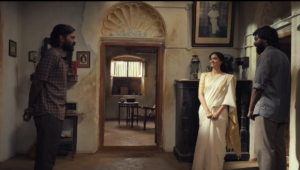
Pictorialism: The Landscape as a Visual Composition
The landscape photography in *Dorothy* deserves particular appreciation.
Tirru’s compositions frequently establish a relationship between the human figure and the vastness of nature. Characters are sometimes positioned towards the edge of the frame, while mountains and open spaces occupy the larger visual field.
Such compositions communicate more than geographical scale. They suggest the limitations of human ego in the presence of nature.
The pictorial quality of these images emerges through the careful organisation of foreground, middle ground and background, the relationship between light and shadow, and the balance between the human figure and the landscape.
The mountain compositions are particularly expressive. The characters are not isolated from the environment; they become part of its visual structure.
This is where cinematography approaches the language of painting.
However, the beauty of these compositions is never merely decorative. Their pictorial quality is connected to the emotional meaning of the scene.

Depth: Creating a Three-Dimensional Emotional Space
Depth is another important aspect of the film’s visual language.
The relationship between foreground, middle ground and background creates a strong sense of spatial continuity. The landscapes extend beyond the characters, establishing a visual scale that enhances their emotional experience.
The use of natural elements in the foreground, the placement of characters within the middle ground and the expansive mountain ranges in the background create a layered visual experience.
Depth also becomes an emotional tool.
The confined spaces of the household communicate restriction. The open landscapes communicate possibility. The movement from one environment to another reflects the gradual expansion of the characters’ emotional understanding.
The image therefore operates on two levels: it establishes geographical space while simultaneously communicating psychological space.

Ilaiyaraaja’s Music: The Emotional Architecture
The contribution of Ilaiyaraaja’s score is central to the film’s emotional experience.
The music evolves with the narrative. The intensity of the early portions gradually gives way to a more tender and intimate musical language.
The score supports the transition from a world dominated by violence and social conditioning towards one in which compassion and acceptance become possible.
Particularly in the latter portions, the music and cinematography achieve a remarkable emotional relationship.
The landscape becomes more than a visual setting. Through the musical treatment, it acquires a sense of spiritual and emotional transcendence.
Tirru’s images provide the visual foundation, while Ilaiyaraaja’s music elevates their emotional meaning.
This is an important example of audiovisual collaboration. Music does not merely accompany the image; it transforms the audience’s perception of the image.
Performances: The Human Element Within the Frame
The performances of Sananth and Rishikanth provide the emotional foundation of the film.
Sananth’s portrayal of Subbu moves from youthful innocence towards emotional maturity. The performance communicates vulnerability within a social environment that discourages it.
Rishikanth’s Karthi embodies the conflict between inherited beliefs and the possibility of acceptance. His emotional journey is not instantaneous; it develops through hesitation, resistance and gradual understanding.
Keerthy Suresh brings warmth and compassion to Dorothy, becoming an important emotional catalyst in the narrative.
Muthukumar’s portrayal of Veeraiya is quietly intimidating. His character represents a social structure in which authority and family honour dominate human relationships.
These performances are strengthened by the visual restraint of the film. The camera observes the actors without constantly imposing an interpretation upon them.
Conclusion: The Art of Visual Storytelling
Dorothy is a valuable study in the relationship between cinematography and emotional storytelling.
Tirru’s visual language demonstrates how texture can create authenticity, pictorialism can transform landscapes into emotional compositions, and depth can communicate the relationship between human beings and their environment.
Karthik Subbaraj’s direction, the performances and Ilaiyaraaja’s music work together to create a cinematic experience in which the emotional meaning of the narrative is carried as much by the image as by the dialogue.
The film’s greatest visual achievement lies in its ability to make the landscape participate in the characters’ transformation.
The mountains, fields and open spaces are not simply beautiful locations. They become an extension of the characters’ inner lives.
For cinematographers, Dorothy offers a profound reminder:
A beautiful image becomes a cinematic image when its beauty has a dramatic purpose.
The true art of cinematography lies not merely in photographing what exists before the camera, but in discovering what that image can make the audience feel.
Dorothy is a film that invites us to experience this possibility.
Legendary Cinematographer and Director PC Sreeram heaps praise on Dorothy as an extraordinary film and milestone in Tamil Cinema
— **CJ Rajkumar
Cinematographer | Author