
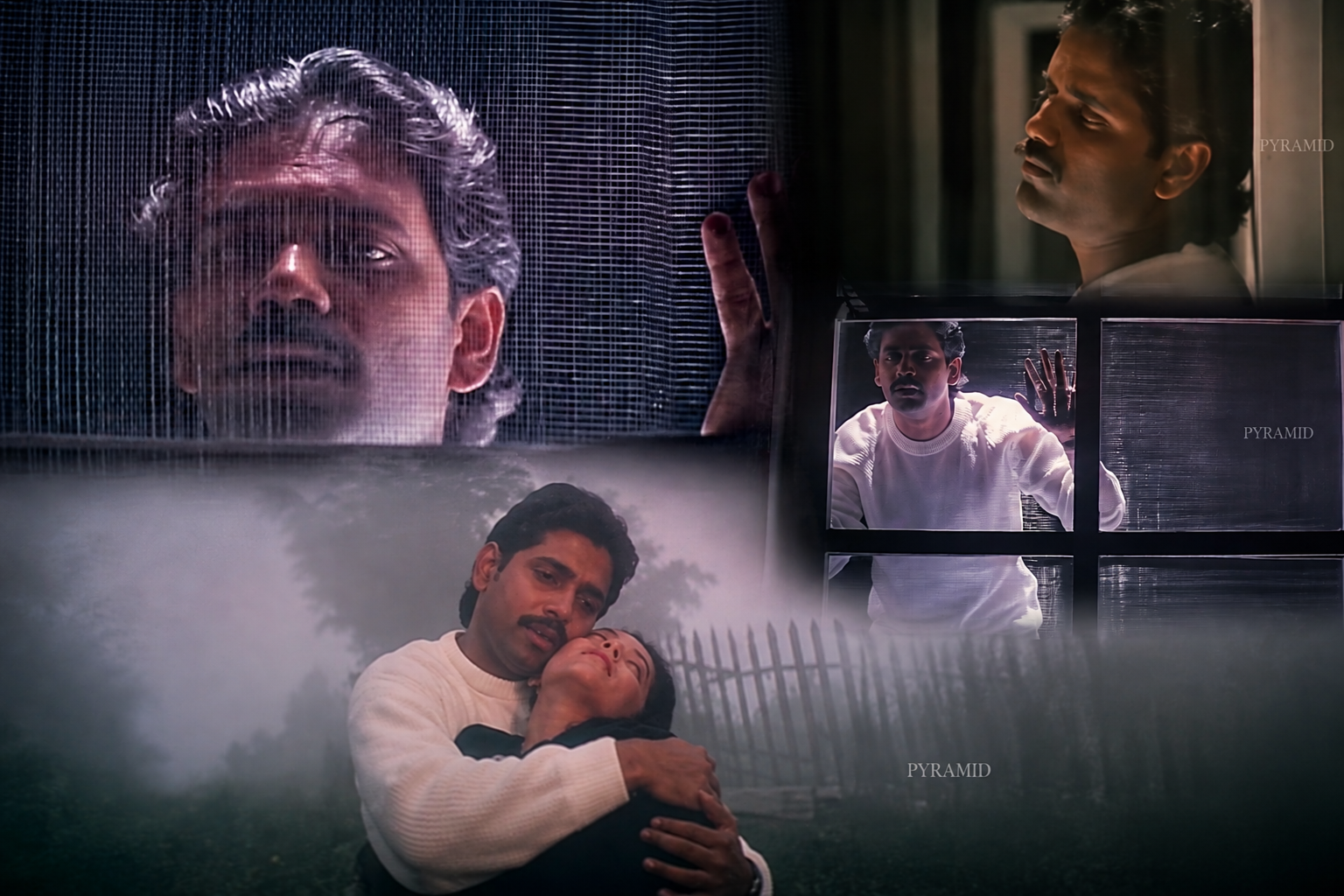
Visual Study of Geetanjali: PC Sreeram!
Aug 13 2026
Views: 874
The Visual World of Geethanjali

A Cinematographic Study of P. C. Sreeram’s Light, Lens, Movement and Atmosphere

When Geethanjali arrived in 1989, its visual impact was almost inseparable from its emotional identity. The film was a love story between two young people who know that their lives are limited, but P. C. Sreeram’s cinematography refuses to photograph that tragedy in a conventionally sombre manner.
Instead, the film creates a world that feels strangely alive.
Mist moves through forests. Sunlight breaks through trees. Water catches the light. Wet surfaces become mirrors. Desert landscapes suddenly become enormous. Night exteriors glow through artificial haze. Interiors are illuminated through reflected light. Lens flares appear almost unexpectedly. The camera moves with the characters rather than simply recording them.
This is the central achievement of Geethanjali: the environment itself becomes part of the emotional narrative.

The film was directed by Mani Ratnam, photographed by P. C. Sreeram and scored by Ilaiyaraaja, with Nagarjuna and Girija Shettar in the lead roles. It was Sreeram’s first Telugu film and came after his important collaborations with Ratnam on Mouna Ragam, Nayakan and Agni Natchathiram.
The result is not merely a collection of beautiful images. It is a carefully constructed visual system.
1. The Fundamental Idea: Photographing a Short Life as a Beautiful Life
The most interesting contradiction in Geethanjali is that the subject is death, but the imagery is full of life.
The characters are terminally ill. Yet the screen is filled with:
– mist
– sunlight
– rain and water
– green landscapes
– movement
– white clothing
– warm interiors
– expansive skies
– flowing fabric
– reflections
– flares
– atmospheric haze
This contrast is crucial.
Sreeram does not allow the illness to dictate a permanently dark visual palette. Instead, the cinematography repeatedly tells us that life becomes more precious precisely because it is temporary.
The visual world therefore oscillates between two states:
Fragility and abundance.
The characters are physically vulnerable, but the world surrounding them is visually immense.
That is why the wide landscapes are so important. Nagarjuna and Girija are frequently placed within spaces much larger than themselves. The frame reminds us that their personal story exists inside a world that will continue after they are gone.
2. Hill station Is Not Just a Location
Ooty is often described simply as the location that gave Geethanjali its romantic appearance. That understates what Sreeram and Mani Ratnam achieved.
The landscape becomes a visual character.
The misty valleys, pine trees, slopes, roads, streams and open fields create constantly changing layers of depth.
The production deliberately exploited Ooty’s early-morning atmosphere. Shooting reportedly began around 5 a.m. and continued until approximately 11 a.m. to capture the soft, misty quality of the environment. When natural mist was insufficient, an ice machine was brought from Madras to augment the atmosphere.
That production decision tells us something important about the cinematography.
The mist was not simply accepted as weather.
It was treated as a photographic material.
3. Mist as a Lighting Medium
Fog and mist perform several cinematographic functions simultaneously.
First, they separate foreground and background.
A distant tree does not have the same density as a nearby actor. Atmospheric perspective naturally creates layers.
Second, mist catches light.
A beam of light that would otherwise remain invisible in clear air can suddenly become perceptible.
Third, mist reduces visual hardness.
Edges become softer. Background contrast decreases. Highlights spread gently.
Fourth, mist creates uncertainty.
A character can emerge from it, disappear into it or become partially concealed by it.
This is particularly appropriate for Geethanjali because the film itself is about an uncertain future.
The characters are moving through a world that is visually beautiful but never completely stable.
4. The Importance of Time of Day
One of the less-discussed achievements of Geethanjali is its sensitivity to the changing quality of natural light.
Morning light in Ooty does not look like afternoon light.
The low sun produces:
– longer shadows
– warmer highlights
– greater atmospheric depth
– backlit foliage
– visible moisture
– softer contrast
Sreeram uses these conditions rather than trying to flatten them into a uniform studio look.
This creates the sensation that the characters actually inhabit a changing world.
The cinematography therefore has a strong relationship with chronology.
Time is visible.
5. Wide-Angle Space and the Small Human Figure
Another important component of the visual language is the relationship between the human figure and the landscape.
Rather than constantly isolating Nagarjuna and Girija in medium close-ups, Sreeram frequently allows the environment to dominate the frame.
The characters become small figures within:
– valleys
– hillsides
– forests
– roads
– open fields
– desert landscapes
This produces two opposite effects.
When the lovers are together, the large environment can make their private happiness feel expansive.
When they are alone, the same environment can make them appear vulnerable.
The landscape therefore changes meaning according to the dramatic context.
The same mountain can represent freedom in one shot and mortality in another.

6. Softness Without Losing Detail
Descriptions of Sreeram’s work on Geethanjali specifically note the combination of wide-angle lenses for the Ooty environment and softer lenses for the lead actors, contributing to the film’s dreamlike quality.
This distinction is extremely important.
The environment is allowed to remain geographically readable.
The faces, however, can receive a gentler treatment.
This creates a hierarchy:
Landscape — reality
Characters — emotion
The landscape tells us where we are.
The lens treatment tells us how the characters feel about being there.
7. The Camera Does Not Merely Follow the Actors
Movement is another defining feature of Geethanjali.
Sreeram’s camera frequently moves with the physical energy of the characters.
Walking, running, turning, playing and travelling become opportunities for camera movement.
This is particularly effective because the movement does not feel mechanically imposed on the scene.
The camera seems to participate in the characters’ experience.
In this sense, movement becomes an extension of performance.
A static camera would simply show two people running.
A moving camera makes us feel the act of running.
8. Water as a Recurring Visual Element
Water appears repeatedly in the visual world of Geethanjali.
It exists as:
– rain
– puddles
– streams
– splashes
– wet surfaces
– reflected light
– atmospheric moisture
Water is particularly useful to a cinematographer because it is never visually neutral.
It reflects.
It refracts.
It catches highlights.
It creates movement.
It can make an ordinary surface photographically interesting.
This is why low-angle details of feet, footwear, vehicles and splashing water become more than inserts.
They turn physical movement into visual rhythm.
Instead of beginning a sequence with a conventional hero close-up, the film can introduce movement first and personality second.
9. Backlight and the Photography of Moisture
Moisture becomes particularly beautiful when it is backlit.
If the light is positioned behind water droplets, mist or spray relative to the camera, the particles become brighter against a darker background.
The result is not simply illumination.
It is texture.
The atmosphere becomes visible.
This technique is particularly compatible with Sreeram’s photographic approach because Geethanjali repeatedly searches for things that exist between the camera and the subject:
– mist
– rain
– foliage
– water
– haze
– flare
These elements create depth.
They prevent the image from becoming a flat arrangement of foreground and background
10. Om Namaha: The Camera and Light Become One Performance
Among the film’s songs, Om Namaha is perhaps the clearest demonstration of the relationship between choreography, camera movement and lighting.
The song is associated with a highly controlled dark environment and a circular camera movement. Available accounts describe it as a single-take trolley-based sequence.
The important point is not simply that the camera moves in a circle.
The movement becomes a method of revealing the actors through changing illumination.
As the camera and/or lighting relationship changes, the couple can pass through different photographic states:
– silhouette
– rim light
– side light
– partial illumination
– fuller facial exposure
– backlit form
The darkness is therefore not empty space.
It becomes the background against which the light sculpts the lovers.
This is classical chiaroscuro translated into a moving cinematic form.
11. The Long Take and the Psychology of Intimacy
A long take has a very different emotional effect from rapid cutting.
When the relationship between two characters is sustained without interruption, the viewer is not repeatedly released from the moment.
The scene has to breathe.
In Om Namaha, the circular movement creates a feeling of continuity.
The camera does not cut away from intimacy.
Instead, it travels around it.
That makes the lighting itself almost performative.
The light becomes a moving partner to the actors.
12. Why Darkness Is Important in Geethanjali
One of the misconceptions about romantic cinematography is that romance requires brightness.
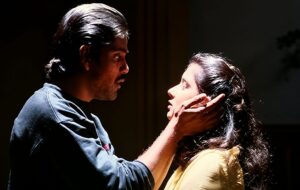 Geethanjali demonstrates the opposite.
Some of its most memorable romantic imagery is built from darkness.
Darkness provides:
– isolation
– intimacy
– contrast
– mystery
– negative space
– visual concentration
When almost everything disappears, the eye is forced toward the illuminated subjects.
This is why the darkness in Om Namaha is not simply low exposure.
It is compositional strategy.
13. O Priya Priya: From Ooty’s Moisture to Jaisalmer’s Heat
The visual world suddenly changes when the film moves to Jaisalmer.
The contrast is dramatic.
Ooty gives us:
green + grey + mist + moisture + softness
Jaisalmer gives us:
ochre + blue + white + dryness + vastness
The song was filmed at the Jaisalmer sand dunes and Gadisar Lake, reportedly with around 100 camels, and was completed in approximately a week.
This is not simply a change of location.
It is a change of photographic vocabulary.
14. The Desert as an Optical Opposite
In Ooty, the atmosphere tends to hide distance.
In the desert, distance becomes enormous.
In mist:
the background disappears.
In the desert:
the horizon expands.
That contrast gives Geethanjali an unusually broad visual range.
Sreeram moves between two extremes:
atmospheric compression
and
geographical expansion.
The lovers can therefore appear either enveloped by their environment or dwarfed by it.
15. White Against Ochre
The use of light-coloured costumes against the desert is particularly effective.
White clothing absorbs relatively little visual attention compared with the enormous ochre field surrounding it.
The figures become almost graphic shapes.
The desert becomes the canvas.
The lovers become moving marks within that canvas.
This is one reason the sequence feels almost painterly.
16. Lens Flare as Emotion
The desert sequences also demonstrate another aspect of Sreeram’s approach: allowing the lens to respond visibly to strong light.
An anamorphic lens can produce characteristic horizontal flare and other optical artefacts when strong sources enter or approach the lens axis.
Rather than treating every flare as an unwanted technical error, cinematographers can use it as part of the image.
In Geethanjali, such optical effects contribute to the feeling that the image is being overwhelmed by sunlight.
The important distinction is:
flare is not merely an effect added to the image; it is a consequence of the image’s relationship with light.
17. Nandikonda: Warmth, Movement and Optical Surprise
Nandikonda Vaagulona shifts the visual language again.
The sequence has a warmer and more playful energy.
Here the landscape becomes less mysterious and more celebratory.
Golden-hour illumination provides warmth, while movement through the countryside creates a rhythmic relationship between performers and environment.
But one of the more interesting aspects is the use of anamorphic flare.
The flare is not necessarily presented as a constant stylistic device.
Its occasional appearance makes it feel spontaneous.
That is important.
A controlled imperfection can make an image feel less manufactured.
18. Ghost Lighting and Theatrical Night Exteriors
The night portions of Nandikonda also demonstrate that Geethanjali was not dependent entirely on naturalistic illumination.
There are moments where the exterior lighting takes on a distinctly theatrical quality.
This is where the idea of ghost lighting becomes useful.
Rather than illuminating the entire location uniformly, controlled sources can create selective pools of illumination and separation.
The resulting night does not attempt to reproduce darkness literally.
It creates a cinematic night.
That distinction is essential for students.
Natural night and photographed night are not the same thing.
19. O Paapa Laali: The Night Becomes Atmosphere
If Nandikonda demonstrates theatricality, O Paapa Laali demonstrates atmosphere.
The night exteriors are treated with mist.
This transforms the lighting.
Without mist, a backlight remains largely invisible.
With mist, the light acquires volume.
The air itself becomes part of the frame.
The night therefore becomes three-dimensional.
Instead of:
black background + actors
we get:
foreground + actors + illuminated atmosphere + receding background.
This is a fundamentally cinematographic use of haze.
20. Interior Lighting: Bounce Instead of Direct Illumination
The interiors of O Paapa Laali offer a different photographic philosophy.
Instead of making the actors look as though a lamp has been placed directly beside the camera, light can be bounced from surrounding surfaces.
This creates:
– larger light sources
– softer transitions
– broader facial illumination
– gentler shadows
– more natural falloff
The resulting light feels as though it belongs to the room.
That is a crucial difference.
A direct source says:
“There is a light on the actor.”
A bounced source can suggest:
“The room itself is luminous.”
21. Interior and Exterior as Emotional Counterpoints
The contrast in O Paapa Laali is therefore not accidental.
The exterior is:
mist + night + atmosphere + distance
The interior is:
reflection + warmth + enclosure + intimacy
The outside world feels mysterious.
The inside world feels protective.
This is exactly how cinematography can support emotional storytelling without dialogue.
22. Aamani Paadave: Silence, Landscape and Morning Light
Aamani Paadave returns to the atmospheric world of Ooty.
The sequence benefits from the interaction of
– early morning light
– mist
– trees
– open landscape
– soft contrast
– controlled camera movement
The light filtering through vegetation can create shafts and patches of illumination.
This is often referred to as crepuscular light or, more popularly, “god rays.”
But technically, the visible beam depends on atmospheric particles scattering the light.
Once again, atmosphere becomes a photographic tool
23. Jagada Jagada: A Different Energy
Jagada Jagada demonstrates that Geethanjali is not simply a soft-focus romantic film.
The visual language becomes more energetic.
Night exteriors, reflective surfaces, vehicles, movement and strong artificial illumination create a much harder visual rhythm.
Wet ground becomes especially useful because it doubles the available light.
A street light does not illuminate only the road.
Its reflection can create a second visual plane.
This effectively increases the amount of graphic information available within the frame.
24. Reflection as a Cinematographic Device
Reflection appears throughout the visual thinking of Geethanjali.
Water reflects.
Wet roads reflect.
Glass can reflect.
Mist scatters.
Flares refract.
These are all ways of making light visible.
The cinematographer is therefore not merely photographing objects.
He is photographing the behaviour of light around objects.
That is one of the deeper lessons of Sreeram’s work.
25. The Film’s Colour Architecture
It is tempting to describe Geethanjali simply as a “green and misty” film.
That is incomplete.
Its visual palette changes according to environment and emotion.
Hill station
– muted greens
– grey skies
– white mist
– soft skin tones
– cool atmospheric values
Jaisalmer
– ochre
– sand gold
– deep sky blue
– white costumes
– strong sunlight
Night exteriors
– deep blacks
– warm pools of artificial light
– coloured reflections
– atmospheric highlights
Interiors
– warm reflected tones
– amber values
– soft shadow
– controlled contrast
The film therefore does not have one palette.
It has a palette of emotional environments.
26. The Relationship Between Colour and Mortality
The most fascinating aspect is that the film rarely uses death as an excuse for desaturation.
Instead, colour becomes evidence of life.
Green vegetation suggests renewal.
Blue skies suggest openness.
Golden sunlight suggests warmth.
White clothing suggests purity and vulnerability.
Mist suggests uncertainty.
Darkness suggests intimacy and the unknown.
The visual vocabulary therefore allows the audience to feel the characters’ limited time without constantly showing sadness.
27. Costumes as Part of the Composition
The costume design works closely with the cinematography.
The actors are frequently placed against landscapes where costume colour becomes an important compositional element.
White against desert.
Dark clothing against mist.
Warm clothing against green environments.
The actors are therefore not simply “dressed.”
They become moving colour shapes within the frame.
This is an important lesson for cinematographers:
Exposure and colour decisions cannot be separated from costume and production design.
28. The Architecture of Depth
One of Sreeram’s most important tools in Geethanjali is depth.
Depth is created through:
– foreground foliage
– atmospheric mist
– backlight
– long lenses or softer rendering where appropriate
– wide-angle environmental compositions
– layers of actors and background
– reflections
– shadow
– practical sources
– movement through the frame
This creates images that feel deeper than a simple flat arrangement
The viewer is constantly encouraged to look through the image
29. Foreground Objects Become Part of the Photography
Leaves, branches, mist, water and architectural elements frequently enter the visual field.
They are not necessarily obstacles.
They become frames within frames.
A foreground element can:
– conceal part of the character
– create depth
– soften the image
– introduce movement
– create visual rhythm
This is especially effective in an outdoor film because nature itself supplies the cinematographer with framing devices.
30. The Camera’s Relationship with the Actors
Sreeram’s photography of Nagarjuna and Girija is also important to understanding their screen presence.
The camera does not simply make them attractive.
It integrates them into their environment.
This is particularly significant because Geethanjali helped establish Nagarjuna’s romantic screen image.
Geethanjali all set to release August 28th 2026.
The images and memories of this film remain afresh.
Article CJ Rajkumar
x
^