
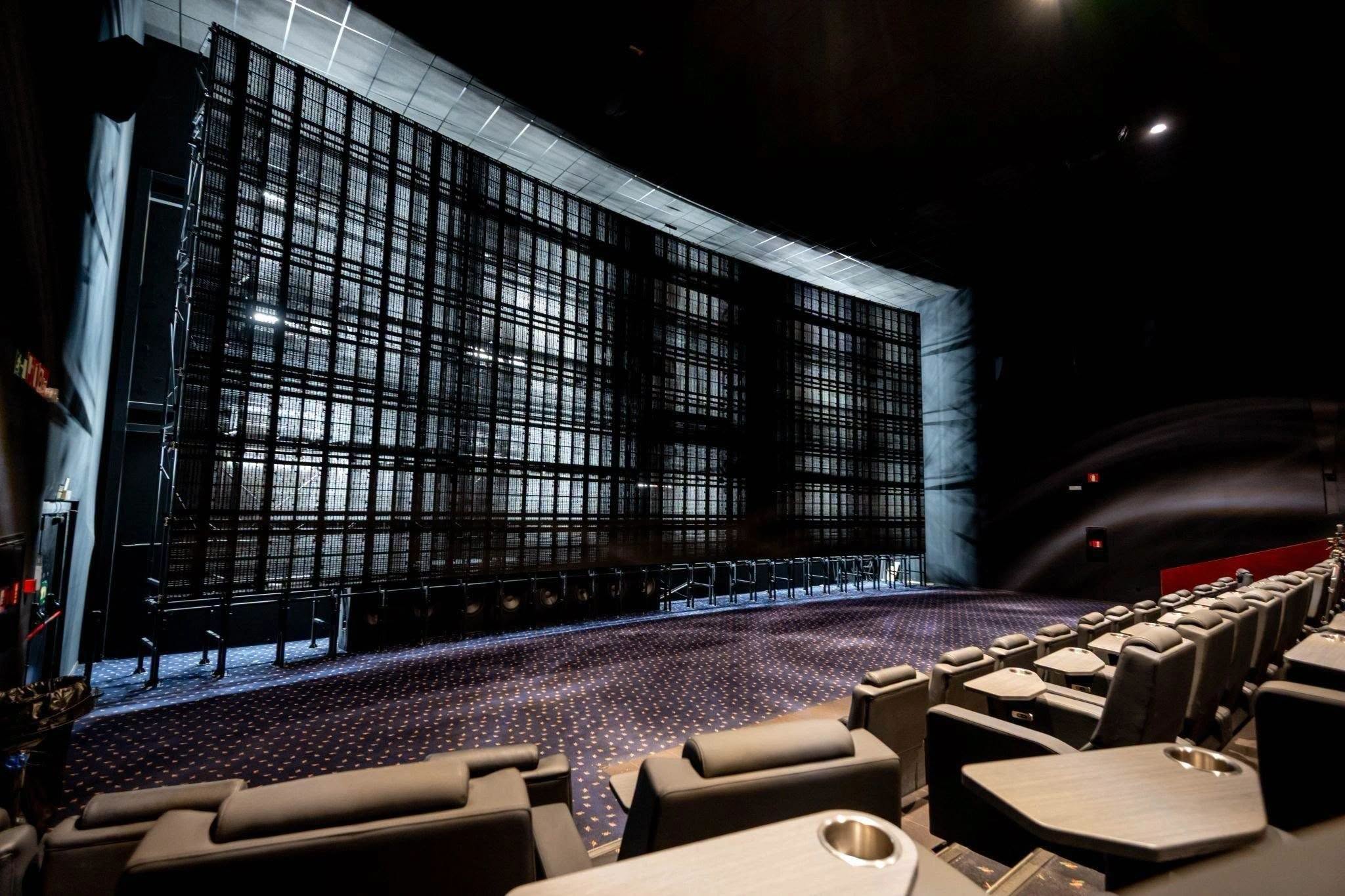
Transparent LED cinema screens!
Jul 14 2026
Views: 461
Acoustic Transparent LED Cinema Screens: The Next Revolution in Theatrical Exhibition
For more than a century, the cinema experience has relied on a simple principle: the image is projected onto a perforated screen, while the sound comes from speakers hidden behind it. The tiny perforations in the screen allow dialogue, music, and effects to emerge directly from the actors on screen, creating the illusion that the voices originate from the characters themselves.
The emergence of Direct View LED (DVLED) cinema screens promised a dramatic leap in picture quality, but it also introduced a major challenge. Unlike perforated projection screens, LED panels are solid structures that block sound. As a result, the center speaker—the most important speaker in a cinema—could no longer be placed behind the screen. Manufacturers had to relocate speakers above, below, or beside the display, compromising one of cinema’s most fundamental principles: sound should come from the image.
This limitation has now been addressed by a new generation of Acoustic Transparent LED Screens, with companies such as Tricorne LED pioneering the technology.
Why Acoustic Transparency Matters
Nearly 70–80% of a movie’s soundtrack, especially dialogue, is reproduced through the center channel speaker.
When audiences hear dialogue coming from above or below the screen rather than from the actor’s mouth, the illusion of realism is subtly broken. While the brain compensates to some extent, filmmakers and sound designers strive for precise audio localization.
Acoustic transparent LED screens restore this principle by allowing sound waves to pass through the display itself while maintaining the advantages of LED technology.
The result is:
Dialogue originates exactly from the actor’s position.
Better synchronization between image and sound.
More accurate sound panning across the screen.
Improved immersion for large-format presentations.
How Does It Work?
The technology uses specially engineered LED modules with microscopic acoustic pathways that allow sound energy to travel through the display while maintaining image integrity.
Unlike conventional perforated projection screens, which depend on thousands of tiny holes, these LED systems are designed so that the structure itself becomes acoustically transparent without introducing visible artifacts.
This allows cinemas to continue placing the Left, Center, and Right (LCR) speakers behind the screen—the gold standard in theatrical sound design.
Visual Advantages Over Projection
LED cinema displays are self-emissive, meaning every pixel generates its own light.
Compared to laser or xenon projection, they offer:
Extremely High Brightness
Traditional cinema projection typically operates around 48 nits (14 foot-lamberts).
LED cinema screens can exceed 300 nits, with HDR capability reaching even higher levels.
Bright scenes retain detail without washing out.L
Infinite Contrast
Since LEDs can completely switch off individual pixels, black levels become exceptionally deep.
Dark scenes reveal subtle shadow detail impossible with conventional projection.
Wider Color Gamut
LED displays reproduce a significantly larger color volume, approaching and exceeding standards such as DCI-P3.
The result is richer reds, deeper blues, and more vibrant imagery.
Superior Uniformity
Projection brightness naturally decreases toward the edges because of optical fall-off.
LED screens maintain nearly identical brightness from center to edge.
No Projection Booth
Without a projector:
Less maintenance
No lamp replacements
No laser alignment
Lower long-term operational costs
More flexible auditorium design
Curved LED Screens
One of the most exciting developments is the arrival of curved acoustic transparent LED displays.
Unlike projection, where curvature introduces optical challenges, LED panels can be manufactured to follow a precise radius.
Advantages include:
Better peripheral vision coverage
Reduced viewing angle issues
Greater immersion
Uniform focus across the audience
Wall-to-Wall Cinema
LED technology removes many physical constraints of projection.
Future auditoriums can feature:
Wall-to-wall images
Floor-to-ceiling displays
No masking systems
No visible screen borders
This creates an experience closer to a giant digital canvas than a traditional movie screen.
Major Installations
Majestic Cineplex – Sri Lanka
One of the world’s first large-scale installations of an acoustic transparent LED cinema screen.
Features:
13-meter-wide display
Wall-to-wall design
Floor-to-ceiling presentation
Already operational for commercial screenings
HOYTS – Australia
Australia’s first curved acoustic transparent LED screen.
Specifications:
82 × 36 feet
Curved architecture
Premium large-format auditorium
Enhanced HDR presentation
Behind-screen speaker placement retained
CineMagnum – Nuremberg, Germany
Currently constructing what is expected to become the world’s largest acoustic transparent LED cinema screen.
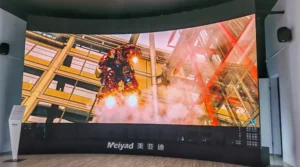
Specifications:
98 × 52 feet
Approximately 30 × 16 meters
Curved design
Full 8K resolution
Wall-to-wall
Ceiling-to-floor
Replacing a former IMAX projection auditorium
This installation represents a major milestone, demonstrating that LED technology is now capable of serving auditoriums traditionally reserved for the largest projection formats.
Implications for Filmmakers
For cinematographers and directors, acoustic transparent LED screens offer a new level of image fidelity:
HDR highlights are rendered with greater impact.
Night scenes exhibit deeper blacks and finer shadow detail.
Color grading can be experienced with enhanced precision.
The elimination of projector flare improves perceived contrast
At the same time, the preservation of behind-screen speaker placement ensures that carefully crafted soundtracks maintain their intended spatial accuracy.
Challenges Ahead
Despite these advancements, widespread adoption will depend on overcoming several challenges:
High installation costs.
Compatibility with existing DCI cinema standards.
Increased power consumption.
Efficient heat management.
Long-term serviceability of large LED panels.
Availability of content mastered specifically for HDR LED cinema.
The Future of Cinema
Acoustic transparent LED screens represent more than an incremental improvement—they signal a fundamental transformation in cinema presentation. By combining self-emissive HDR visuals, curved wall-to-wall architecture, 8K resolution, and true behind-screen audio, they overcome one of the last major barriers to LED-based theatrical exhibition.
For the first time, cinemas can preserve the authenticity of sound localization while delivering a visual experience that surpasses the limitations of traditional projection. As installations expand from Sri Lanka to Australia and Germany, this technology is poised to redefine premium moviegoing and may well become the benchmark for the next generation of large-format cinemas.
Article by
CJ Rajkumar
x
^